
01
Core technology
MARS reverse-engineering engine — built and owned entirely in-house.
- Not a reseller, not OEM — 100% engine ownership
- Format spec updates shipped quarterly, in-house
- Custom formats added on customer request
Patents held 14
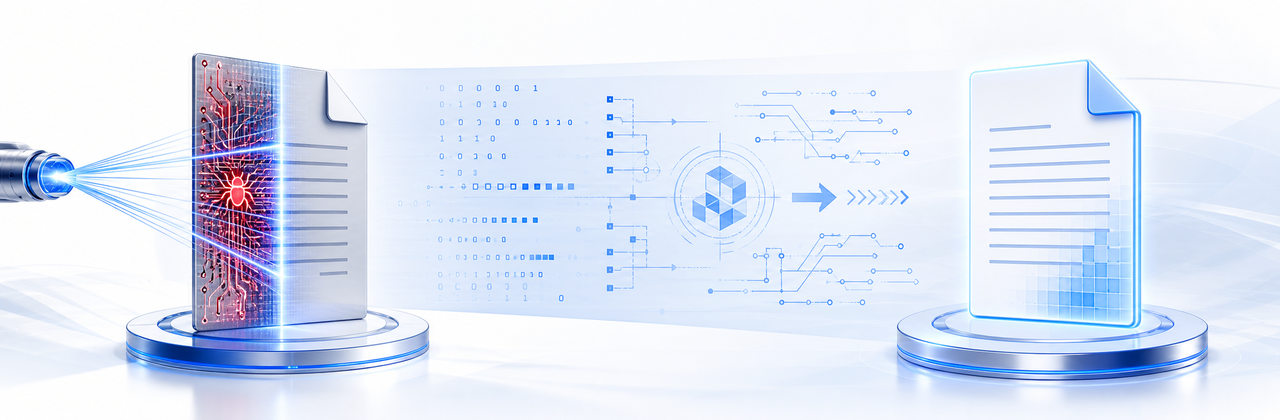
In a broad security market, we chose to specialize. Reverse-engineering file structure from the inside out, neutralizing the threats we find, and safely reassembling — that single focus built the MARS engine.
Most CDR vendors compete on format coverage alone. SecuLetter has held a leadership position simultaneously across four axes — core technology, format coverage, performance, and Korea-native design.
MARS reverse-engineering engine — built and owned entirely in-house.
309 supported file formats — roughly 1.5× the global CDR vendor average.
TTA GS Grade 1 · avg. analysis time 12.02s.
HWP and Korean regulated-industry environments designed in as defaults.
Behavior-based systems execute files in a virtual environment and observe the result. Four real-world conditions break that premise — and we've seen each one confirmed during actual PoCs.
Attacks that produce no behavior are undetectable by design. Fragmentary payloads — embedded in documents, images, and scripts that themselves execute no code — are growing.
BNK Busan Bank adopted SecuLetter because behavior-based systems couldn't catch non-executable document attacks.
A sandbox needs at least 3–5 minutes per file. When email and public-service portal upload traffic surges, the entire business workflow stalls.
Daishin Securities replaced a behavior-based system with SecuLetter to resolve throughput constraints.
Global solutions are weak on Korean HWP and HWPX formats. The primary entry path for government and public-sector campaigns flows straight through them.
Ebest Investment & Securities adopted SecuLetter after it correctly diagnosed an HWP attack.
Samples that use sandbox evasion — VM-aware, time-delayed, user-action-triggered — produce no behavior in a virtual environment. Detection rates drop further.
Daishin Securities replaced a behavior-based system with SecuLetter due to low detection rates against evasion-equipped samples.
We picked the criteria that come up repeatedly in real procurement RFPs. Competitor names are referenced by their published product category.
| Criterion | OURSSECULETTER | AGlobal CDR · US | BGlobal CDR · EU | CSandbox APT · Korea |
|---|---|---|---|---|
| Approach | Disassemble and reassemble | Disassemble and reassemble | Disassemble and reassemble | Behavior observation (execution-based) |
| Supported formats | 309+ | ~220 | ~180 | Unlimited (requires execution time) |
| HWP · HWPX | ● All versions · PostScript | ◐ HWP partial | ○ Not supported | ◐ Execution only |
| Avg. processing time | 34 ms / file | ~60 ms | ~80 ms | 2–5 min (sandbox wait) |
| Zero-day and unknown malware | ● Structurally removed | ● Structurally removed | ● Structurally removed | ○ Passes if not detected |
| Sandbox-evasion resilience | ● Does not execute | ● Does not execute | ● Does not execute | ○ Defeated by evasion |
| TTA GS certification | Grade 1 | Foreign certifications only | Foreign certifications only | Grade 1 |
| Korean public procurement listing | ● Listed | ○ Not listed | ○ Not listed | ● Listed |
| Korean-language direct support | ● Direct from HQ | ◐ Via local partner | ◐ Via local partner | ● Direct |
| Engine ownership | 100% in-house | In-house | In-house | Partially OEM |
Every figure is sourced from third-party certification, a public challenge, or live production data. We publish the source alongside every number.
TTA software evaluation results. Average over a 1,000-file sample. 2.5× faster than the published industry benchmark.
Participated in the KISA APT defense challenge in 2023 and 2024. Detected and sanitized all 124 sample variants.
Major families: CFB · OOXML · PDF · HWP · HWPX · HTML. Includes 17 Korean public document formats.
Cumulative deployments since the Korean public procurement listing. 92% renewal rate. Over 100M files processed per day on average.
Global CDR products treat the Korean environment as a locale. SecuLetter was designed with HWP, Korean public procurement, and Korean-language support as architectural premises from the very first line of code.
HWP 3.0–5.x · HWPX · HML · HWT · CELL · SHOW. The only solution on the market that disassembles the PostScript stream inside HWP.
Korean public procurement listed · Common Criteria certified · cleared for security suitability by a national agency. Deployed at 40+ public organizations.
Direct technical support from engineers at the Pangyo HQ. Average 1.4-hour first-response on urgent incidents. Full Korean-language technical documentation.
On-premise and air-gapped network deployment by default. No logs or analysis data leave Korea. Compliant with Korean electronic-finance supervision regulations.
Not vendor copy — sentences written by the security leaders themselves. We only publish quotes where the organization has agreed to be named.
"We see 300+ HWP-based spear-phishing attempts per month. The previous solution only told us suspicious. After switching to SecuLetter, we receive a disassembled, safe version delivered directly — past the suspicion stage entirely. The biggest difference: the SOC is freed from making the verdict call.
CISO · public-sector agency
"We evaluated two global vendors alongside SecuLetter. In the end, the decision came down to three things — depth of HWP support, response speed, and Korean-language documentation. SecuLetter clearly led on all three. The two custom formats we requested during the PoC were added within two weeks.
Head of security · financial services (one of the four major holding groups)
"We operate in defense, so every file is a candidate for classified information. A deployment where logs and analysis data don't leave the country and stay on-premise was a contract prerequisite. SecuLetter already had that as the default architecture — no custom work required.
Information security officer · defense contractor
18 organizations per year transition from sandboxes or global CDR products. Avg. migration: 3.2 weeks · zero service interruptions · 100% transition success.