CUSTOMERS · DEPLOYMENT GUIDE

Without changing your existing infrastructure —
3–6 months to production.

PROCESSv3.2 · 2026-Q1
BASELINEGovernment and finance standard
REFERENCE100+ org average
OWNERSecuLetter CX team

The SecuLetter standard deployment process runs in 7 stages: Inquiry → Benchmark → PoC → Design → Build → Acceptance → Operations. Each stage's inputs, outputs, and duration are defined up front — so approval documents and audit-response materials get written without guesswork. Average duration: 3 months (light), 6 months (standard).

  • STEP 01
    Inquiry
    0.5mo
  • STEP 02
    Benchmark
    1mo
  • STEP 03
    PoC
    1mo
  • STEP 04
    Design
    1mo
  • STEP 05
    Build
    0.5–1mo
  • STEP 06
    Acceptance
    1mo
  • STEP 07
    Operations
    Annual
Trailing 12 months — avg. lead time 4.1 months · avg. PoC win rate 78% · updated April 2026
OPTION · 01

Pick the deployment model that fits your environment.

Choose on-premises, cloud (DISARM), or hybrid based on network policy, organization size, and regulatory requirements. All three share the same MARS engine, CDR pipeline, and ConTI intelligence — so policies and detection data carry over when you switch models later.

On-premises BASELINE

The standard configuration for government, finance, and defense. Installed as a dedicated appliance on the internal network — inserted into cross-network file transfer, web upload, and mail server paths. The self-contained, no-external-connection design fits both regulated security-suitability and cross-network requirements.

  • Form factor
    2U rack appliance × HA (active-active)
  • Throughput
    49K to 315K /day (SLF baseline)
  • Install location
    Internal network — no outbound internet
  • Compliance
    Network separation · security suitability
    • Zero outbound traffic — intelligence updates delivered offline
    • API integration with existing DRM and SIEM (REST, Syslog, CEF)
    • Clear operating ownership — your in-house security team runs it solo
    On-premises integration LOGICAL VIEW
    External Internet Gateway One-way File server EFS · DRM SLF Appliance MARS · CDR · HA SIEM · Syslog ConTI (Opt.) Operator portal
    Existing infrastructure SecuLetter additions File flow (unchanged)
    OPTION · 02

    Without touching your network architecture —
    we insert only at the ingress points.

    SecuLetter products are inserted only where files enter from outside — cross-network file transfer, mail receipt, web upload. Internal file servers, DRM, and business systems stay as they are. The MARS engine intervenes only at the moment a file enters.

    Standard integration architecture — compatible with regulated network-separation policies DIAGRAM · v3.2
    EXTERNAL Email receipt SMTP / M365 Web upload Citizen · proposal Cross-network One-way SECULETTER SecuLetter ingress MARS engine · CDR sanitization · Intelligence SLF / SLE Gateway SLCDR Sanitization ConTI Intelligence INTERNAL · unchanged Mail server · business systems Existing Exchange · WAS DRM · document centralization Fasoo · MarkAny · SoftCamp SIEM · SOC ArcSight · Splunk · QRadar
    A
    Inserted only at ingress — zero internal changes

    Mail server, DRM, and SIEM stay as-is. SecuLetter intervenes only at the moment a file enters from outside.

    B
    Standard protocols with bypass on failure

    Supports ICAP, SMTP, Syslog, CEF, REST, and SAML. Automatic bypass on failure prevents business interruption.

    C
    Pre-mapped to ISMS-P and network-separation requirements

    Pre-mapped to cross-network file transfer requirements and information security management — usable as audit evidence with no separate design pass.

    PROOF · 03

    Impact on operating speed, in numbers.

    Based on the TTA GS Grade 1 test (200,000 real files), 100+ organizations in production, and averages across government and finance customers. Designed to leave existing infrastructure performance materially unchanged.

    M01 12.0s Avg. attachment analysis SLE · TTA GS certified measurement (12.027s)
    M02 34ms Per-file sanitization SLCDR · 309+ formats · finance-sector average
    M03 0% Existing infrastructure changes Mail server, DRM, and SIEM left unchanged
    M04 99.4% 3-year SLA compliance P1/P2 incident response — government and finance combined
    Measurement basis: TTA GS test report · 12 months of operating logs across 100+ customer sites. Individual results vary by configuration and throughput. Methodology and original test report
    TIMELINE · 04

    7-stage standard process, with each stage's inputs and outputs.

    Each stage has predefined inputs, output documents, and owners. Drop directly into your procurement schedule to walk senior approvers and auditors through.

    TOTAL
    3 – 6months
    MIN · light
    3months (BMT abbreviated)
    STD · standard
    4 – 5months
    MAX · large
    6months (HA · multi-site)
    References
    100+org average
    1. 01
      0.5 moAvg. 2 business days

      Inquiry and requirements

      STEP 01

      PoC request or procurement inquiry. Joint sales and engineering kickoff call (60 min). We confirm network topology, primary file types, throughput, and regulatory requirements, then agree on PoC scope.

      Provided by you

      • Organization overview and contacts
      • Current security stack (antivirus, sandbox, DRM, etc.)
      • Target zone (cross-network file transfer, mail, web upload)
      • Daily throughput and max file size

      Delivered by SecuLetter

      • Kickoff summary and PoC SoW draft
      • NDA, if needed
      • Assigned technical account manager
    2. 02
      1 moLab 2 wks + report 2 wks

      Benchmark testing

      STEP 02

      In the SecuLetter lab or an isolated environment at your site, we validate detection, sanitization, and performance against 10,000 to 200,000 real files. Same protocols as the KISA and TTA evaluations — measuring detection rate, average response, and false-positive rate in parallel.

      Provided by you

      • Sample files (in-house malware plus normal business files)
      • Target format coverage (PDF, DOCX, HWP, etc.)
      • BMT environment spec (VM or bare metal)

      Delivered by SecuLetter

      • Benchmark report (20–40 pp.)
      • Vendor comparison with performance charts
      • Open-issue list
    3. 03
      1 moInstall 3 days + operate 4 wks

      On-site proof of concept

      STEP 03

      Deploy in TAP/mirror mode in your production environment and observe live traffic. No blocking — we detect and classify only to validate false-positive rate and business impact up front. Your security team drives the SLF/SLE dashboard directly.

      Provided by you

      • Mirror traffic collection points (switch or server)
      • Operator accounts and SSO integration info
      • Log format and SIEM integration targets

      Delivered by SecuLetter

      • PoC report (detection count, business impact, FP rate)
      • Operator training (1 session)
      • Final deployment recommendation
    4. 04
      1 moDesign 2 wks + approval 2 wks

      Design and procurement approval

      STEP 04

      Based on BMT and PoC results, we finalize hardware spec, HA configuration, network gateway integration, and log retention. Decide on procurement path — multi-vendor contract or Innovative Procurement Item sole-source. Cite the certifications page directly in your procurement workflow.

      Provided by you

      • Confirmed deployment scale and budget
      • Procurement path (multi-vendor, sole-source, or open tender)
      • HA and DR requirements

      Delivered by SecuLetter

      • Final proposal with detailed quote
      • Procurement item ID and contract terms
      • Signed procurement approval
    5. 05
      0.5–1 moOn-site 2–4 wks

      Build and installation

      STEP 05

      Appliance delivery, rack mount, network connection, and policy migration. Active-active redundancy and bypass configurations are standard — cutover happens with no business interruption. Integration tested against file servers, mail servers, DRM, and SIEM.

      Provided by you

      • Install schedule and site access
      • IP and VLAN allocation table
      • Admin contacts for systems we integrate with

      Delivered by SecuLetter

      • Install completion report
      • Architecture and policy design document
      • Full handover documentation
    6. 06
      1 moParallel operation 4 wks

      Acceptance and stabilization

      STEP 06

      Run in detection mode first to tune false positives and finalize exception policy. Switch to block mode in the final week. Daily monitoring and weekly reports for two weeks post-cutover. Security-suitability evidence delivered as a bundle.

      Provided by you

      • Operating policy (block, quarantine, sanitization criteria)
      • Exception targets (specific senders or formats)
      • Alert recipients and escalation paths

      Delivered by SecuLetter

      • Acceptance confirmation
      • Security-suitability evidence pack
      • Audit response kit
    7. 07
      AnnualStanding — 24/7 option

      Operations and annual support

      STEP 07

      Maintenance contract (15% annual standard) covers updates, signature distribution, and incident response. Quarterly operations review, semi-annual threat briefing. With a ConTI subscription, threat intelligence is shared in real time.

      Provided by you

      • Annual maintenance contract
      • Incident and inquiry channels (email, phone, portal)
      • Regular-review attendee list

      Delivered by SecuLetter

      • Quarterly operations report
      • Semi-annual threat briefing
      • SLA fulfillment log and patch history
    SCENARIOS · 05

    Which pattern matches your environment?

    Four content-ingress paths — cross-network file transfer, email, public web portals, and document repositories. Each card summarizes the configuration, average deployment time, operating KPIs, and representative references.

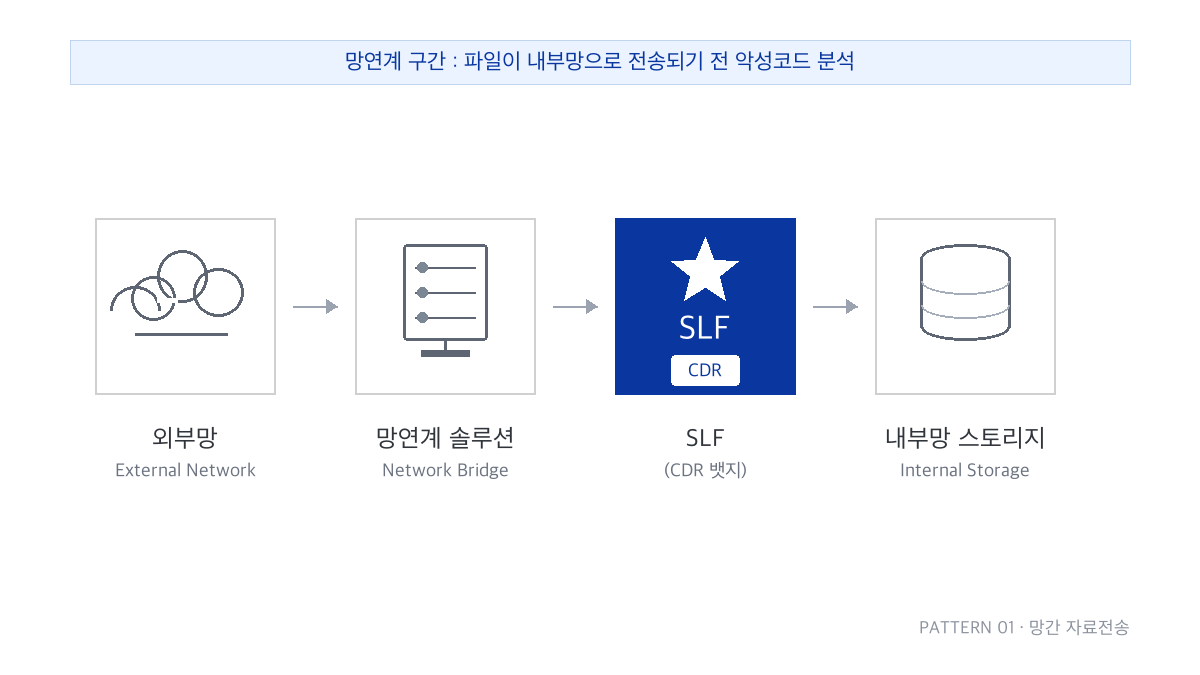
    PATTERN 01

    Cross-network file transfer

    External-to-internal file flow through the network gateway

    Cross-network file transfer deployment architecture
    SLF+SLCDRGateway API
    Avg. deployment
    3–4 months
    Daily throughput
    49,000–315,000 items
    Avg. analysis
    < 12s

    REFS · National postal center · Power utility · Commercial bank

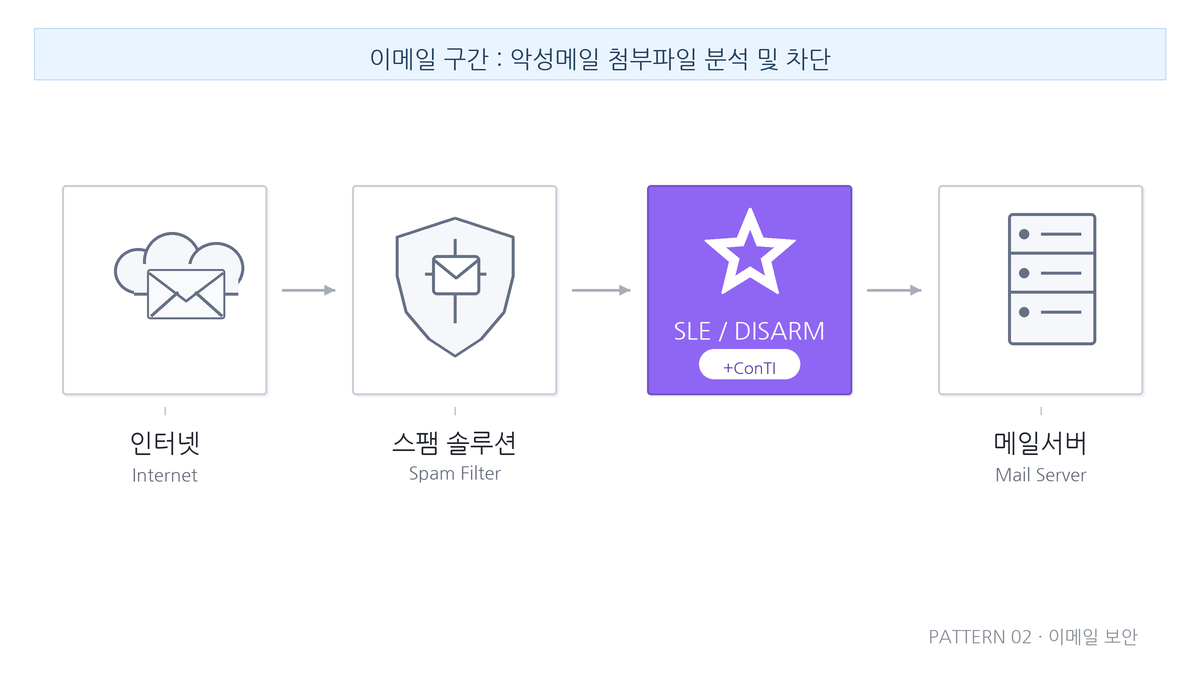
    PATTERN 02

    Email security

    Inline mail gateway with attachment sanitization and URL rewriting

    Email security deployment architecture
    SLE (on-premises)DISARM (cloud)+ConTI
    Avg. deployment
    2–3 months
    Daily throughput
    160,000–912,000 items
    New threats learned
    50/day (KT AI)

    REFS · Defense prime · Top-tier brokerage · University

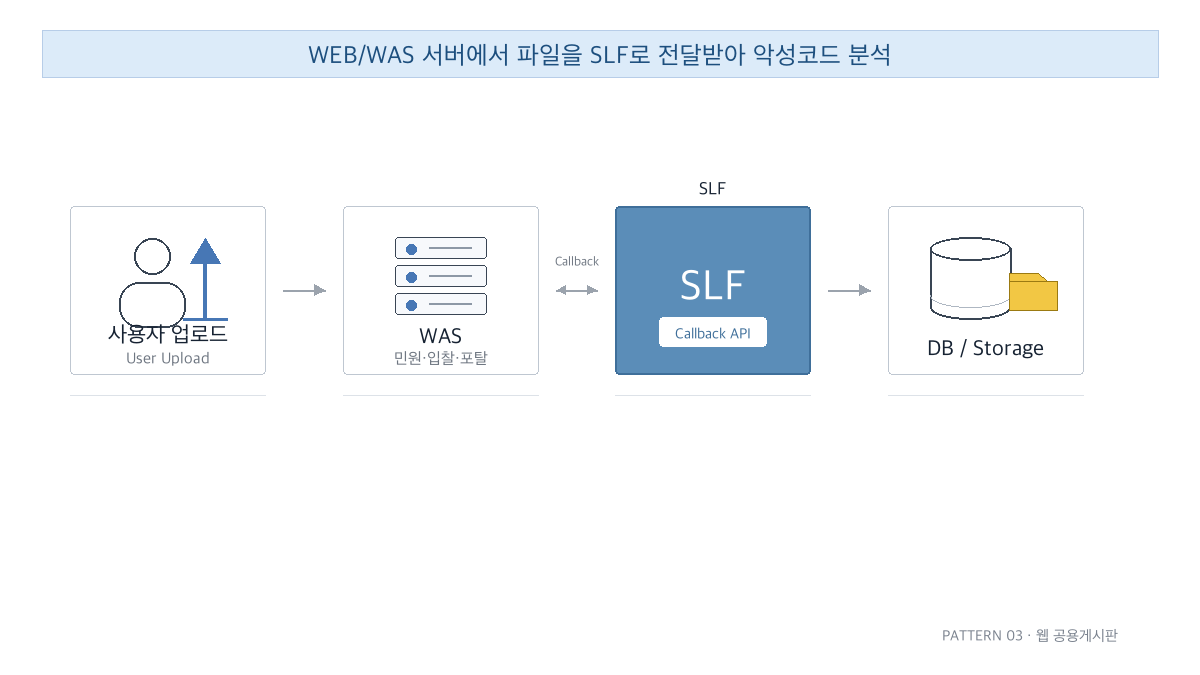
    PATTERN 03

    Public web portals

    Public-service portal, tender, and e-government upload security

    Public web portals deployment architecture
    SLF+SLCDRWeb Callback API
    Avg. deployment
    3–5 months
    Web-system load impact
    −65% vs. polling
    Dynamic analysis
    < 10s

    REFS · National health agency · Korea Internet & Security Agency · Provincial government

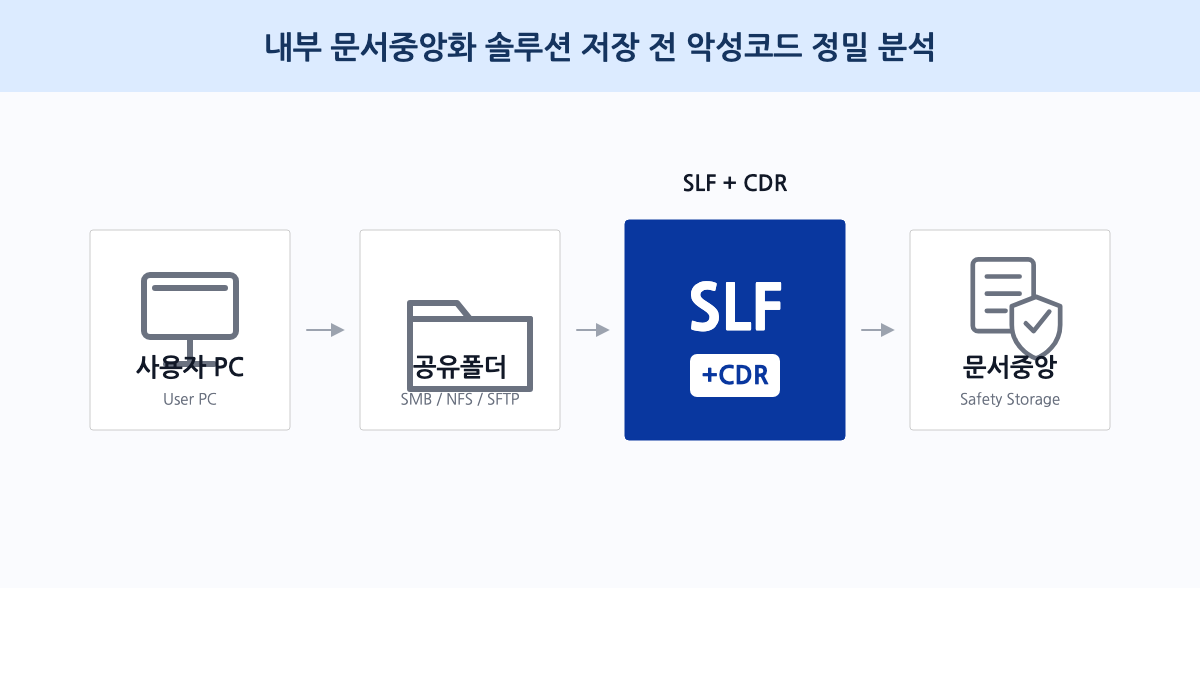
    PATTERN 04

    Document repository

    Pre-scan before ECM and DRM storage

    Document repository deployment architecture
    SLF+SLCDRECM API
    Avg. deployment
    4–6 months
    False positives
    ≤ 0.1%
    Sanitization
    34ms / file

    REFS · National R&D agency · Multiple government organizations

    FAQ · 06

    Twelve frequently asked questions.

    What government and finance buyers most often ask during PoC and procurement. Answers include the supporting page and relevant contract clauses.

    Contracts consist of product license, hardware (where applicable), and annual maintenance. The standard maintenance rate is 15% per year, adjusted for night and holiday support, on-site staff, and other options.

    Procurement via the multi-vendor government contract (item ID 23456789) fixes the unit price with no separate tender; sole-source via Innovative Procurement Item (IP-2023-0914) is also available. Quotes scale by throughput, HA, and optional modules (CDR, ConTI).

    Contract clause§5.3 MaintenanceProcurement ID23456789

    No dedicated headcount required. Designed so an existing security operator handles dashboard monitoring in 10–20 minutes per day. At typical deployment scale the average operating load is 4–6 hours per month.

    For 24/7 coverage, SecuLetter SI and MSSP partners offer managed services as an option. Most finance customers integrate by forwarding logs to their existing SIEM/SOC without adding headcount.

    Operating load4–6 h/mo

    Not overlap — complementary. Antivirus targets known signatures; sandboxes target behavior analysis of executables. The MARS engine disassembles the structure of non-executable files (documents, PDFs, HWP, images) through reverse engineering — covering exactly the surface other tools miss.

    A major defense contractor runs SecuLetter SLE alongside an existing sandbox; top-tier brokerages integrate it with their NGFW and DLP, consolidating detection data in a single portal.

    SectionSandbox limitsCustomersDefense + brokerage references

    Average file processing is 12.027s for SLE (measured on 200,000 real files under TTA GS) and 34ms for SLCDR sanitization. No perceptible delay in the workflow — 10–20x faster than typical sandboxes (2–3 minutes).

    At peak, spare nodes in the HA configuration distribute load. Even if a temporary queue forms, original mail delivery is not delayed — only attachments enter a separate processing queue.

    Performance12.027s · 34msCertificationTTA GS Grade 1

    SecuLetter products hold Common Criteria certification, 100% APT detection in the KISA evaluation, TTA GS Grade 1, and an Innovative Procurement Item listing — usable as evidence for cross-network file security, ISMS-P information security management, and national security-suitability evaluation.

    On deployment we bundle requirement-mapping sheets, audit Q&A, and operational evidence from comparable customers. Your account manager attends in person during audit season for technical defense.

    Evidence/en/customers/certifications/References47 government · 28 finance

    Standard API and Syslog integrations are validated against major cross-network file transfer products and DRM systems (Fasoo, MarkAny, SoftCamp), and 100+ organizations already run them in parallel. File formats, extensions, and decryption ordering are tuned per environment.

    Environments with conflict risk are validated up front during the PoC in TAP/mirror mode. We have a track record across special environments — OT and defense networks included.

    Validated5 DRM · 3 gateway products

    The one-month lab benchmark test is free. The one-month on-site PoC is also free by default for government and finance buyers; a separate quote may apply if special-environment setup is needed (for example, a dedicated lab for an air-gapped network).

    BMT and PoC include the result report, one operator training session, and on-site engineering support. If the customer chooses to adopt, operating artifacts (signatures, policies) from that period roll directly into the production deployment.

    BMTFree · 1 monthPoCFree · 1 month

    Standard SLA: P1 incidents (service outage) resolved within 4 hours, with response within 1 hour; P2 and P3 handled on business-day terms. Major government and finance customers add 24/7 hotline plus quarterly on-site review as an option.

    Incident logs are delivered as quarterly SLA fulfillment reports — drop-in ready for security audits and executive reporting. Trailing 3-year SLA compliance: 99.4%.

    SLAP1 4hCompliance99.4%

    Licensing is based on daily throughput (items/day) and processing nodes. If user count grows but attachment volume stays flat, no expansion is needed; once throughput crosses thresholds, nodes are added within the HA configuration.

    Unititems/day · nodes

    Acceptance includes one standard operator training (4 hours) and one administrator deep dive (2 hours). Onboarding materials — operations manual, policy templates, dashboard playbooks — are distributed as PDFs.

    One additional free training session per year; further sessions priced separately. Re-training is available on staffing changes.

    StandardOperator 4h · Admin 2h

    Yes. With role-based access control (RBAC), operators manage allowlists, exceptions, and alert policies directly; sensitive policies (block criteria, signatures) are restricted to administrators or the SecuLetter engineering team.

    AuthorizationRBAC, 4-tier

    Default is 1-year retention plus 3-year archive (optional), extendable to finance and public-sector audit requirements. Detection events, original files, and sanitized output are all queryable, with real-time SIEM delivery via Syslog and CEF.

    For suspected incidents, the SecuLetter security research team provides forensic analysis support — annual contract or per-incident.

    Retention1Y + 3YFormatSyslog · CEF
    NEXT STEP · 07

    You can start benchmark testing as early as next week.

    On a PoC request, a technical account manager is typically assigned within 2 business days to set up the kickoff call. Get a single consolidated walkthrough of lab benchmark testing, on-site PoC, and procurement paths.

    • 7 stagesStandard process
    • 3–6 monthsDeployment lead time
    • 100+Reference organizations
    • 99.4%SLA compliance