
CDR SANITIZATION · SLCDR
Every file from the web,
delivered disarmed.
Don't detect — strip out anything that could be risky, without judgment calls. 34 ms per file. 309+ formats. Original layout preserved.
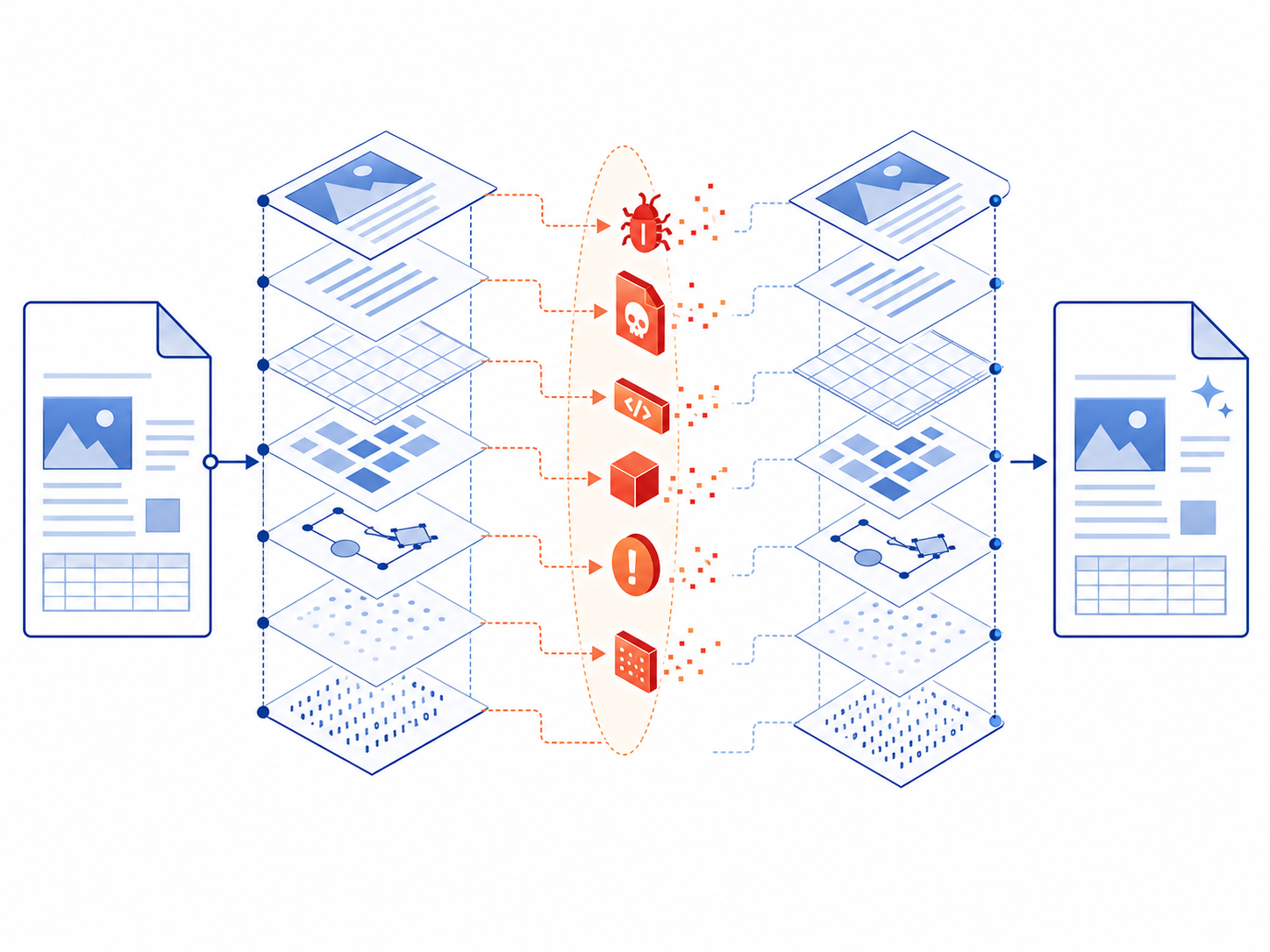
Detection vs. disarming — a fundamentally different approach.
Detection-based security blocks only what it recognizes. CDR neutralizes both known and unknown threats at the source.
"Is this file malicious?"
- Lets the file through when no signature matches
- Defenseless against zero-day
- Blocks only what it can identify
- Vulnerable to sandbox evasion
"Anything that could be risky — gone."
- Strips every risky element regardless of signature
- Neutralizes via structural disassembly
- Reduces the threat surface to nothing
- No behavior to observe — nothing to evade
Three attacks detection can't stop.
Sandbox-evasion attacks
Malware that recognizes the sandbox and stays dormant. Detection has to observe behavior; CDR never observes — so there's nothing to evade.
Time-delayed attacks
Malware designed to fire 24 hours after delivery — silent during detection, active later. CDR disassembles the file itself, so the execution moment is structurally removed.
User-action triggers
Malware that activates only on a specific page turn or click. CDR removes the trigger from the file structure — the condition can never fire.
Six categories of threat elements removed.
SLCDR strips six categories of threat elements from the file at the structural level.
Macros and scripts
VBA, JavaScript, PowerShell. Removes every auto-execute code path inside OOXML, HWP (Hangul Word Processor, Korea's standard document format), and PDF documents.
Embedded OLE objects
Extracts and removes embedded executables and external-link objects (Object Linking and Embedding) inside documents.
Malicious URLs
Embedded URLs in documents. Strips every link that would lead to malicious pages or drive-by downloads.
External data references
DDE and external XML references. Severs every connection that would call out to an external server when the file is opened.
Metadata and hidden data
Author information, edit history, Track Changes. Removes elements that risk exposing personal or internal information.
Threats inside archives
Files inside ZIP, 7z, and RAR. Recursively handles nested files, including password-protected archives.
Six-stage sanitization process.
From file intake to safe output — structural disassembly and reassembly remove the threat at the source.
-
File intake
Ingest via ICAP, REST, or SMTP standard APIs
-
Structure parsing
Disassemble CFB, OOXML, and PDF internal structures
-
Threat identification
Detect the six element categories — macros, OLE, URLs, external references
-
Threat removal
Precisely remove only the identified elements
-
Document reassembly
Restore original layout, formatting, and comments
-
Safe output
34 ms · identical look to the original
Specifications
| Per-file processing time | 34 ms (average) |
|---|---|
| Supported file formats | 309+ formats (HWP, HWPX, PDF, DOCX, XLSX, PPTX, images, archives, and more) |
| Structure parsing | Full support for CFB (OLE2), OOXML, PDF, images, and archives (ZIP, 7z, RAR) |
| Original preservation | Layout, formatting, images, comments, and Track Changes preserved |
| Deployment | On-premises appliance or cloud SaaS |
| Integration | ICAP · REST API · SMTP · WAS callback |
| Standalone use | Runs on its own without SLF or SLE |
| Certifications | 100% detection rate (Korean cybersecurity agency benchmark) · TTA GS Grade 1 · featured in Gartner CDR research as a Representative Vendor |
How it works
The moment a file passes through the SLCDR engine, its internal structure is fully disassembled and safely reassembled.
Deployment references
Trusted institutions across public-sector, finance, and insurance have chosen SLCDR.
Strips risk elements from partner-submitted and citizen-submitted documents. 2M+ files per year. Reference deployment for standalone CDR sanitization.
- 2M+ documents sanitized per year
- 100% of externally submitted documents handled
Deployed email attachment sanitization for finance. Zero malware infections since launch.
- All email attachments sanitized
- Zero malware infections
100,000 citizen-submitted attachments per day. Web application server (WAS) callback API integration delivers full coupling with the business system.
- 100,000 citizen documents per day
- WAS callback API integration
Document security.
See it for yourself.
Run a benchmark with your own files and samples. Deploys inline without changes to your existing infrastructure—results report typically within 3 days.