
What is Content Security · CATEGORY 101

Document files are
the most common
attack path.

Per IBM X-Force 2025, 99% of cyber attacks arrive through document files. Email gateways already strip executables (.exe) — but macros, scripts, and malicious links embedded inside Word, PDF, and HWP (Hangul Word Processor) documents fall outside what conventional security can catch by design.

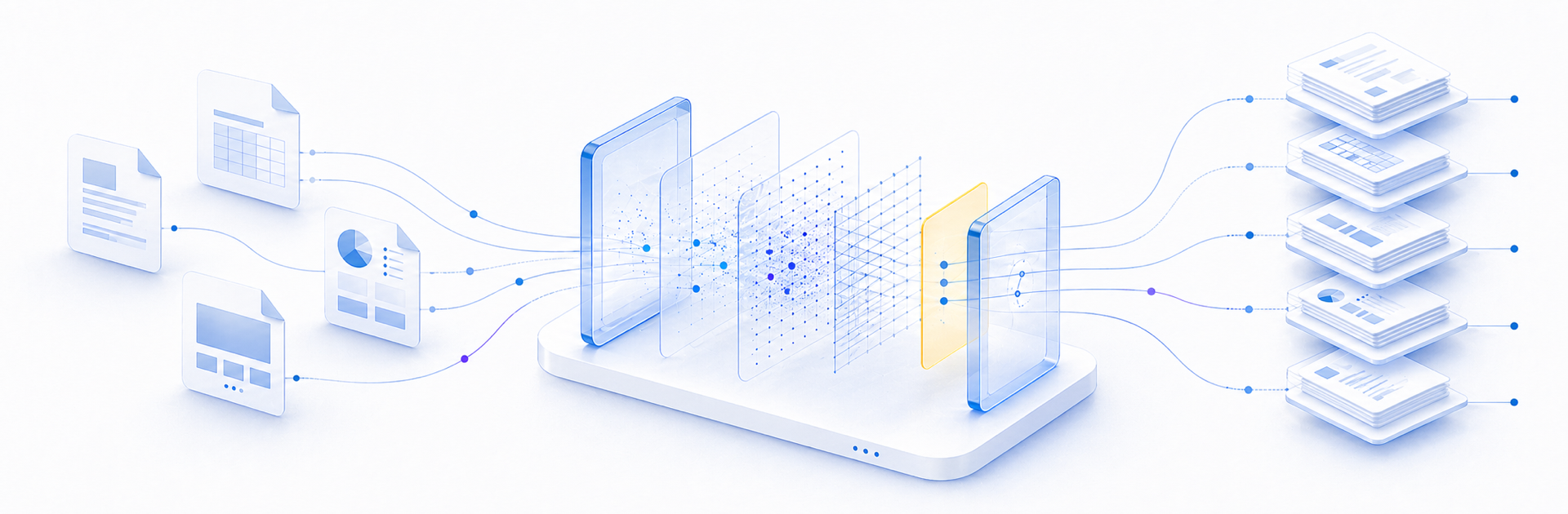
Document files as the primary attack path — multiple file formats funneling into the security gateway
FILE ANATOMY · 01

Looks like a document. Behaves like a runtime.

Word, Excel, PDF, and HWP files are not simply text and tables. Their formats expose multiple streams capable of executing code. Adversaries plant macros, scripts, embedded OLE objects, and malicious links into those streams so that merely opening the document triggers execution.

  1. 01

    Macros (VBA, JavaScript)

    Code embedded inside Office documents. A single click on Enable Content can trigger privilege escalation and remote payload download.

  2. 02

    Embedded OLE objects

    The mechanism that lets one file carry another. The canonical path for executables disguised as innocent documents.

  3. 03

    PostScript and script streams

    Rendering languages used inside HWP and PDF files — the primary vector for recent attacks against regulated public institutions.

  4. 04

    Hyperlinks and external resources

    Documents configured to fetch content from attacker infrastructure. The malicious payload loads only the moment a user opens the file.

Q3-Report.docx Threat inside
\\WordDocument Body text and formatting Safe
\\Metadata Author, last modified Safe
\\VBA_Macros Executes code on open (Auto_Open) Exec
\\OLE_Object_1 Embedded HTA — payload trigger Exec
\\Styles Fonts and paragraph styles Safe
\\Hyperlink_Rel Outbound HTTP request to C2 infrastructure Net
→ With no click and no edit, simply opening the file activates three streams at once.
WHY SANDBOX FAILS · 02

Three classes of attack sandboxes can't catch — by design.

Execution-based analysis — sandboxes and APT appliances — opens a file inside a virtual machine and watches for malicious behavior. But adversaries design malware so that no behavior ever occurs. With nothing to observe, the sandbox has nothing to report.

LIMIT · 01

Sandbox-evasion (VM-aware)

Malware inspects CPU features, registry keys, and mouse-movement patterns to determine whether it's running inside a VM. If it concludes yes, it stays dormant and exits cleanly — the sandbox logs a benign verdict.

VMWARE · DETECTED
NO-OP → Observed: clean
Observed behavior 0
LIMIT · 02

Time-delayed payloads

The payload does not execute on open; it waits — 30 minutes, 2 hours, sometimes days — until a timer expires. A sandbox window averages 2–3 minutes; if nothing fires in that window, the verdict is clean.

ANALYSIS · 03:00 / 180:00
WAIT → Analysis window closed
Scheduled trigger T+48h
LIMIT · 03

User-action-triggered payloads

Malware fires only when a real user would act — scroll to page 3, click a specific button, enable edit mode. There is no human in a sandbox, so the trigger conditions never fire.

TRIGGER · ON_EDIT_CLICK
IDLE → Conditions unmet
Required condition Human only
Bottom line

All three classes share the same root cause: there is no observable behavior to inspect. Sandboxes are built to watch behavior — the principle itself can't cover this territory.

THE TURNING POINT · 03

We don't try to identify the threat.
We neutralize it.

Detection asks: is this file malicious? CDR asks a different question entirely — are there executable elements inside? If so, remove them.

Before · the conventional approach

Detect

Pattern match → verdict → allow or block

01 Receive file +0s
02 Signature and heuristic match AV
03 Observe execution in a VM 2–3 min
04 Unknown → allow PASS
! A 99% detection rate is a 1% breach rate. Zero-day exploits, sandbox-evasion techniques, and time-delayed payloads sit squarely inside that 1%.
After · SecuLetter CDR

Disarm

Disassemble structure → strip executable elements → safely reassemble

01 Receive file +0s
02 Disassemble against the format spec MARS
03 Strip every executable element 34 ms
04 Reassemble with identical layout SAFE
There is no "unknown" state to bet on. Anything potentially executable is removed up front. Verdict uncertainty disappears at the structural level.
Core principle

Instead of hunting for what is already known, disassemble everything and safely reassemble.

HOW IT WORKS · 04

MARS does not execute the file.
It reads it at the binary level.

Where a sandbox watches behavior, MARS reverse-engineers the format specification and decodes the structure itself. Because it reads the code without running the file, even malware engineered to hide its behavior cannot slip through — by design.

Analogy · the conventional approach

CCTV waiting for a crime

Records only after the act occurs. An attacker who hides their behavior walks past CCTV in plain sight.

Analogy · MARS

Identification by fingerprint and DNA

Identifies by composition alone — no behavior required. Dangerous structures reveal themselves without execution.

MARS ENGINE · PIPELINE FILE-IN → 5 STAGES → SAFE-OUT
STAGE 01

Format identification

True file type identified by magic bytes and internal structure — never by extension. 309+ format specs built in.

309 specs
STAGE 02

Structural disassembly

Every internal stream is parsed against the format unit — CFB, OOXML, PDF objects, HWP records.

binary level
STAGE 03

Threat identification

Executable elements — macros, embedded OLE objects, scripts, external resource references — inspected by reading the code itself.

no execution
STAGE 04

Structural-level neutralization

We disarm, not just detect. Every executable element is stripped under a zero-trust default.

34 ms
STAGE 05

Reassemble and deliver

Layout, comments, and hyperlink schema preserved. End users see no difference.

safe.docx
12.02s
Avg. analysis time · TTA GS Grade 1
34ms
Sanitization per file
309+
File formats supported · industry-leading coverage
FORMAT COVERAGE · 05

Every format adversaries use —
including HWP.

CFB, OOXML, PDF, HWP, HWPX, images, archives, and scripts. All major formats — including the HWP family, the primary vector for attacks against regulated public institutions in Korea.

309+ SUPPORTED FORMATS

Korean public documents

18
.hwp.hwpx.hml.hwt.cell.show

Office documents

42
.doc.docx.docm.rtf.odt.dot.dotx

Spreadsheets

36
.xls.xlsx.xlsm.xlsb.csv.ods

Presentations

24
.ppt.pptx.pptm.pps.ppsx.odp

PDF and e-documents

14
.pdf.xps.oxps.epub

Images

58
.jpg.png.gif.bmp.tiff.svg.webp.heic

Archives

48
.zip.rar.7z.tar.gz.alz.egg

Scripts and executables

32
.js.vbs.ps1.bat.hta.wsf

Media and other

37
.mp4.eml.msg.html.xml.json
Format families CFB · OOXML · HWP · HWPX · PDF · HTML
Vs. competing products Industry ~200 · SecuLetter 309+
Preserved after sanitization Layout, comments, and hyperlink schema
Certifications TTA GS Grade 1 · Common Criteria · Korean public procurement listed
POC · BENCHMARK READY IN 3 DAYS

Document security.
See it for yourself.

Run a benchmark with your own files and samples. Deploys inline without changes to your existing infrastructure—results report typically within 3 days.

NDA upfront Government procurement approved Deployed across national ministries Common Criteria EAL2 certified